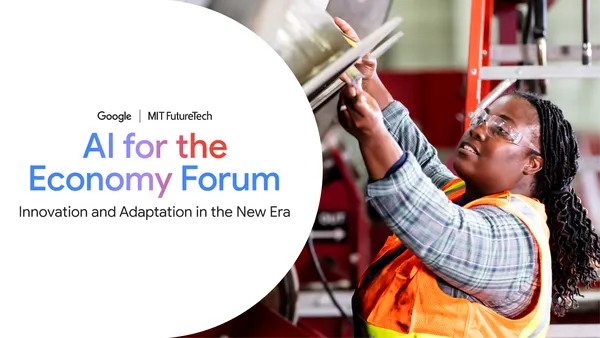

Google and MIT FutureTech just held their first AI for the Economy Forum in Washington D.C. The premise is refreshingly honest: neither the benefits nor the risks of AI are automatic. We get to shape how this plays out. That’s not just a nice sentiment — it’s a call to actually do something.
So what did Google announce? Two things worth paying attention to: new research money and more training programs.
Research money that actually goes to people who study this stuff
Google’s AI & Economy Research Program is funding external researchers to answer the hard questions about AI’s impact on work and the economy. They’ve got a Visiting Fellows program bringing in heavy hitters like MIT’s David Autor. Their Digital Futures Project already funded work from Ben Armstrong and Julia Shah at MIT, who found that the most successful AI deployments minimize drudgery, promote learning, and foster collaboration. That’s not shocking, but it’s good to see someone actually studying it.
Now they’re expanding. Google.org is handing out grants and Google Cloud credits to a new group of researchers studying AI’s impact on labor markets, sector-specific transformations in manufacturing and healthcare, and the policy environments needed to maximize workforce opportunity. They’re also funding a global cohort of research institutions. Internally, they’re looking at how generative AI affects knowledge-worker productivity and the economics of AI agents.
To guide this work, they’ve lined up an advisory board that actually has credibility: Nobel Laureate Michael Spence, Cambridge’s Dame Diane Coyle, and former PIMCO CEO Mohamed El-Erian. That’s not a bad group to have in the room.
Training programs that sound practical
The second piece is training. Google’s funding programs to train healthcare workers and create apprenticeships in high-demand fields. They’re not just throwing money at generic “digital skills” programs — they’re targeting specific sectors where AI is already changing the job landscape.
I’ve seen too many corporate training initiatives that end up being checkbox exercises. Google has a track record here — their Grow with Google programs have actually trained millions of people. The question is whether these new efforts will scale beyond the pilot phase and reach the workers who need it most, not just the ones already in tech-adjacent roles.
What I’m watching
The forum itself brought together economists, industry leaders, policymakers, and experts. That’s a good start. But forums are easy. The hard part is translating conversation into action.
I’m most interested in the research findings from the grantees. If they produce actionable data on which interventions actually help workers transition, that’s worth more than any number of press releases. The advisory board gives me some confidence that the research won’t be junk science designed to make Google look good.
On the training side, the healthcare focus is smart. That’s a sector with massive labor shortages and clear use cases for AI-assisted workflows. Apprenticeships in high-demand fields also make more sense than generic retraining programs that don’t connect to actual jobs.
The bottom line
Google is putting real money into understanding AI’s economic impact and helping workers prepare. The research program is well-structured with credible advisors. The training programs target specific, high-need sectors. None of this guarantees good outcomes, but it’s a more serious effort than most corporate AI initiatives I’ve seen.
The forum was day one. The real test will be whether the research leads to better policy decisions and whether the training programs actually help people find better work. I’ll be watching.
Comments (0)
Login Log in to comment.
Be the first to comment!