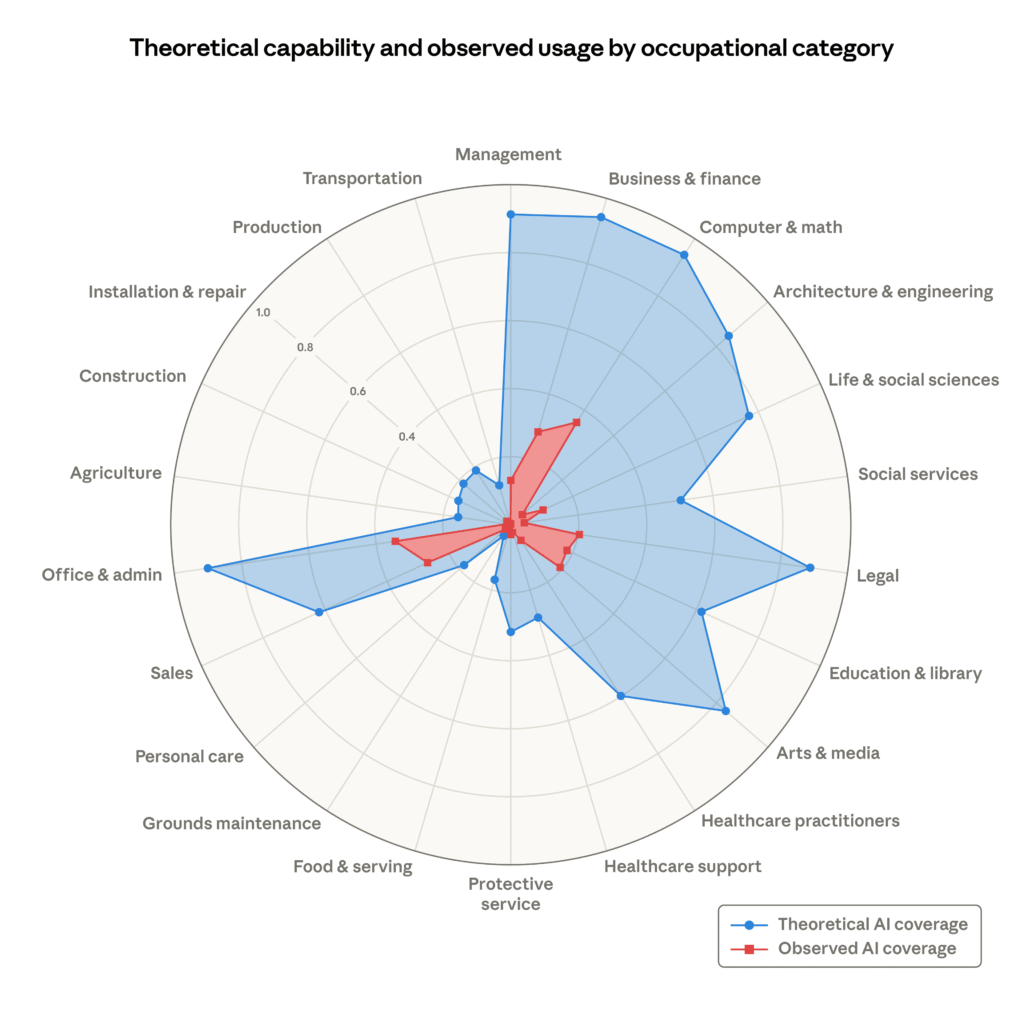

You’ve probably seen this chart floating around this month. It comes from an Anthropic report on AI and the labor market, and it’s designed to show two things: the current “observed exposure” of occupations to LLMs (in red) and the “theoretical capability” of those same models (in blue) across 22 job categories.

The red part is interesting enough on its own, but the blue area is what grabs attention. At a glance, it suggests LLM-based systems could theoretically handle at least 80 percent of the individual tasks in a huge range of human occupations. The blue covers everything from Arts & Media and Office & Admin to Legal, Business & Finance, and even Management.
Looks like Anthropic is predicting LLMs will eventually eat a massive chunk of the US job market, right?
Well, not exactly. When you dig into what that “theoretical capability” actually means, the picture gets a lot less dramatic. That blue field isn’t a prediction of job replacement. It’s a collection of educated guesses — some outdated, some heavily speculative — about where AI might improve human productivity. Not where it takes over entirely.
Anthropic’s own methodology makes this clear if you read past the headline graphic. The “theoretical” numbers are based on expert assessments of what current LLMs could do if applied optimally, not what they will do in practice. There’s a big gap between “can theoretically perform this task” and “will replace a human worker doing this task.” Real-world deployment involves costs, risks, regulatory hurdles, and plain old human reluctance to trust a model with critical work.
I’ve seen this pattern before. A company releases a graph that looks like a jobs apocalypse, the internet panics for a day, and then someone actually reads the fine print. Anthropic isn’t saying the blue area represents jobs that will vanish. They’re saying it represents tasks where LLMs could add value if someone bothers to build and deploy the right system.
That’s a very different thing. And honestly, it’s a more useful way to think about AI’s economic impact. The scary story gets clicks, but the boring story — incremental productivity gains, task augmentation, and slow adoption — is probably closer to what we’ll actually see.
Comments (0)
Login Log in to comment.
Be the first to comment!