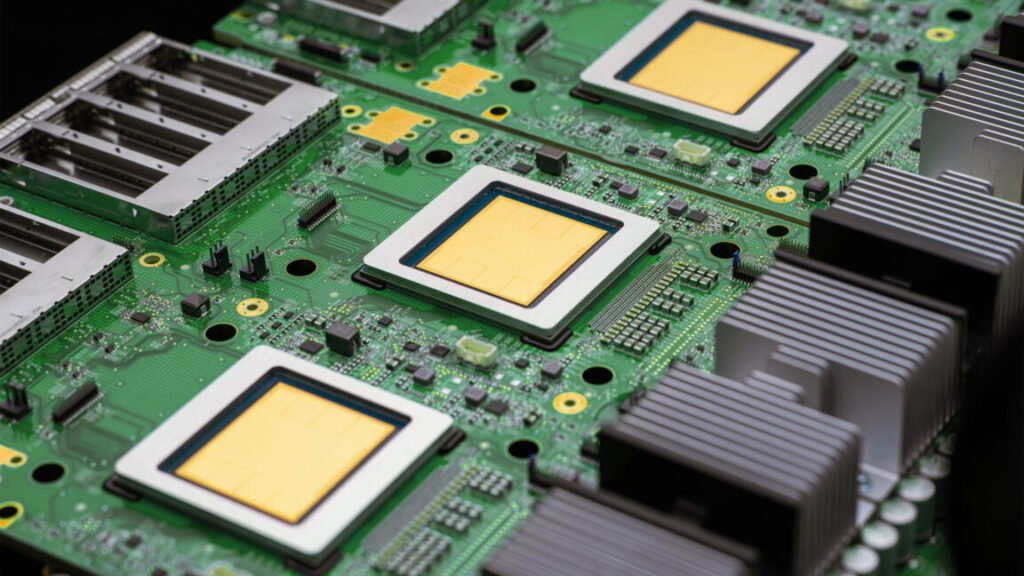

Every big AI company is hoarding Nvidia H100s and B200s like they’re going out of style. Google? They’ve been doing their own thing for years with custom Tensor Processing Units, and they just announced the next step: two new TPUs, not one.
The eighth-gen TPUs split into the TPU 8t for training and the TPU 8i for inference. This isn’t just a faster version of last year’s Ironwood chip. Google is making a pointed argument that the “agent era”—where AI systems act autonomously, make decisions, and interact with the world—demands fundamentally different hardware than what came before.
I’ll be honest: I’ve seen this “new era” pitch before. Every chip launch comes with a grand narrative about how everything has changed. But this time, the split makes sense. Training a frontier model is a brute-force problem: shove as much data through as many matrix multiplications as possible, as fast as possible. Inference, especially for agents that need to respond in real time and chain multiple calls together, has a completely different profile. It’s latency-sensitive and needs to balance memory bandwidth with compute efficiency.
The TPU 8t is built to compress training timelines from months to weeks. That’s not just marketing fluff—Google has the scale to actually pull that off with their internal workloads. The TPU 8i is more interesting to me because inference is where the money gets made (or burned). If agents are going to run complex tasks without a human babysitting every step, the hardware needs to handle that efficiently without melting the power budget.
What I don’t know yet is how these compare to Nvidia’s latest on raw specs. Google tends to keep the detailed performance numbers close to the vest until customers actually get their hands on them. But the dual-chip approach tells me they’re thinking beyond just benchmark chasing.
This is higher than I expected for a mid-cycle refresh. Usually TPU generations are incremental. Splitting into two distinct silicon designs suggests Google sees the agent workflow as a genuine inflection point, not just marketing spin.
If you’re building on Google Cloud, this means your training and inference pipelines might finally stop competing for the same pool of resources. That alone could be worth the migration headache for some teams.
Comments (0)
Login Log in to comment.
Be the first to comment!