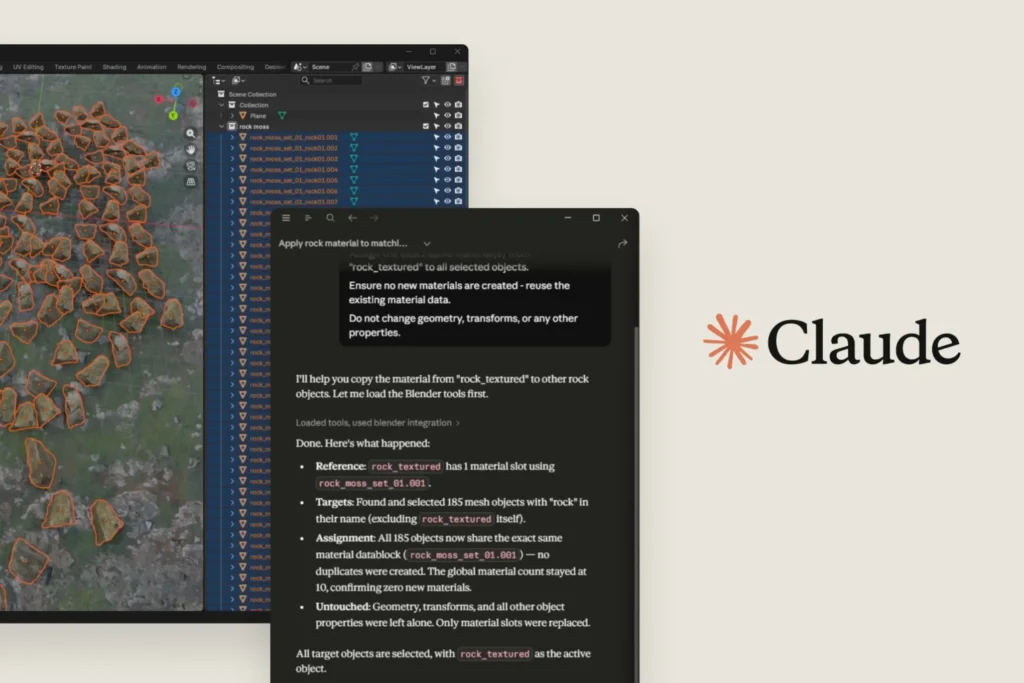

Anthropic just dropped something that caught my attention: a set of connectors that let Claude plug directly into creative software like Adobe’s Creative Cloud suite, Affinity, Blender, Ableton, and Autodesk. No more copying and pasting prompts or exporting files manually.
This is the company’s latest push into the creative space, following the launch of Claude Design earlier this month. The idea is straightforward: instead of treating Claude as a separate tool you tab over to, you can now have it reach into your actual creative apps, grab data, and even take actions.
The Adobe connector, for instance, can draw from Photoshop, Illustrator, and After Effects. In Blender, you can debug scenes, build new tools, and batch-apply object changes directly from the chat interface. Ableton users can probably expect similar workflow shortcuts for music production. Autodesk integration suggests 3D modeling and CAD work could get a conversational assistant.
I’ve seen this kind of “AI inside your tools” approach before — Microsoft’s Copilot, GitHub’s Copilot for code, even some plugin experiments for Photoshop. But Anthropic is going wider than most by targeting multiple creative disciplines at once. That’s ambitious, and honestly, a bit risky.
The big question is execution. Connectors are only as good as their API access and stability. If Claude can’t reliably read a Blender scene or apply a filter in Photoshop without weird errors, the novelty wears off fast. I’ve been burned by half-baked integrations before. Anthropic needs to make sure these connectors are robust enough for real production work, not just demos.
Another thing: pricing. These connectors likely require a Claude Pro subscription or enterprise plan. For freelancers and indie creators, that’s an extra monthly cost on top of already expensive software licenses. I hope Anthropic offers a reasonable tier for individual users, not just teams.
Still, the potential is real. Imagine describing a lighting adjustment in natural language and having Claude tweak your Blender scene. Or asking it to batch-export all your Photoshop layers as PNGs with specific naming conventions. That’s the kind of time-saver that could actually make a difference in a deadline-driven workflow.
I’ll be watching how the community reacts over the next few weeks. Early adopters will quickly find the pain points. If Anthropic listens and iterates, this could be a genuine game-changer for creative professionals. If not, it’ll be another interesting experiment that fades into the background.
For now, I’m cautiously optimistic. It’s nice to see a major AI company treating creative tools as more than just text generators.
Comments (0)
Login Log in to comment.
Be the first to comment!