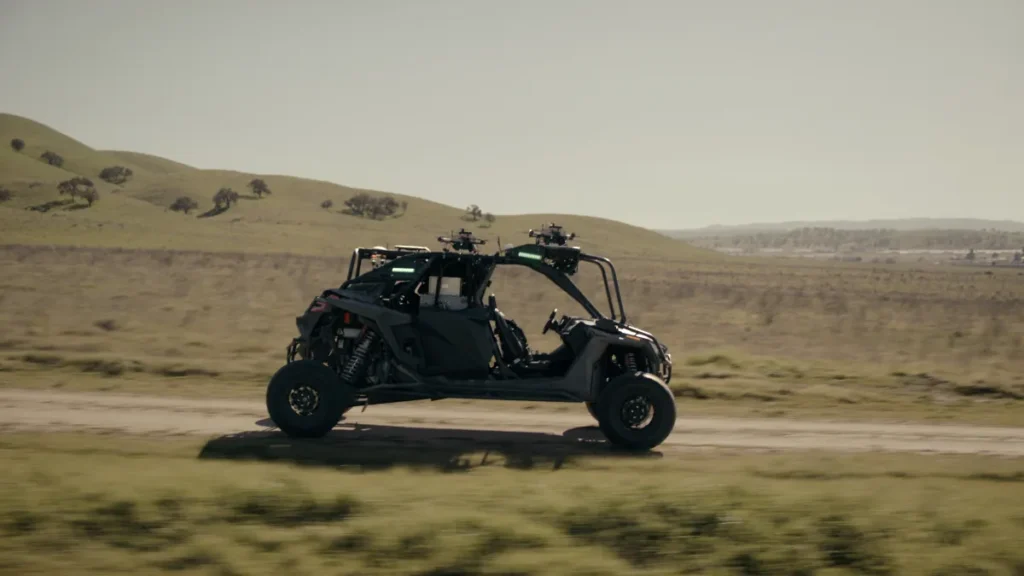

Colby Adcock’s Scout AI just closed a $100M round to keep building AI agents for military use. That’s a lot of money, even by defense tech standards. I wanted to see what that kind of cash actually buys on the ground, so I went to their bootcamp.
It’s not what I expected. No polished demo rooms or slick corporate offices. The training ground is a patch of dirt somewhere outside a city I’m not allowed to name. There’s a lot of dust, some makeshift obstacles, and a handful of vehicles that look like they were assembled from spare parts. That’s the point.
The core idea here is straightforward: give one soldier the ability to control multiple autonomous vehicles at once. Not just drive them remotely, but have them act semi-independently—scout ahead, flank a position, carry supplies, or provide covering fire. The human isn’t piloting each unit; they’re giving high-level commands and letting the AI handle the execution.
During the demo, a single operator managed three ground drones and two aerial ones simultaneously. The operator was using a tablet interface that looked more like a strategy game than a military control system. Draw a path, set a waypoint, designate a zone to monitor. The AI figured out the rest. One drone got stuck on a rock; another rerouted automatically to cover its area. It wasn’t perfect—there was a lag spike that made one of the aerial drones wobble—but it worked well enough to make you think.
Scout’s approach is different from what most defense contractors are doing. Instead of building expensive, specialized hardware that costs millions per unit, they’re focusing on software that can run on cheaper, off-the-shelf drones. That’s a bet that could pay off if the military decides it needs quantity over quality. $100M suggests some people believe that bet is right.
Adcock himself was on site, which surprised me. He’s not the type to stand in the back and let engineers do the talking. He was pointing out flaws in the demo before anyone else noticed them. “That sensor fusion is still too slow,” he said at one point, while the drone was still flying. I appreciate that kind of honesty. Too many founders would have glossed over it.
The funding round included some names I recognize from the defense venture world, plus a few newcomers. I’m not going to list them all—you can read the press release for that. What matters is the valuation and the implied timeline. $100M at this stage means they’re planning to scale fast, likely aiming for field deployment within two years. That’s aggressive for military tech, where procurement cycles usually take a decade.
There are obvious ethical questions here. AI controlling weapons, even semi-autonomously, is a line that makes people uncomfortable. Scout is careful to frame this as “augmenting human decision-making” rather than replacing it. The human is always in the loop, they say. But the loop gets wider with every software update. I don’t have a clean answer on that, and neither did anyone I talked to at the bootcamp.
What I can say is that the tech works better than I expected, given the constraints. It’s not polished. It’s not ready for prime time. But it’s further along than most people realize. If you’re interested in where defense AI is headed, Scout is one to watch—not because they’re the flashiest, but because they’re actually out in the dirt, breaking things and fixing them.
Comments (0)
Login Log in to comment.
Be the first to comment!