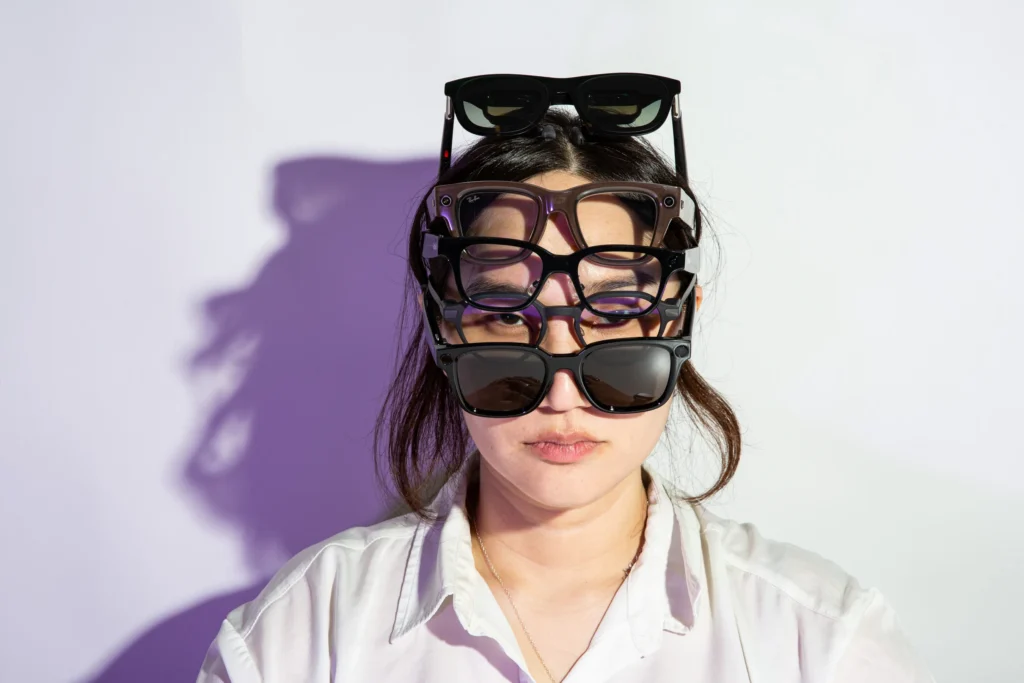

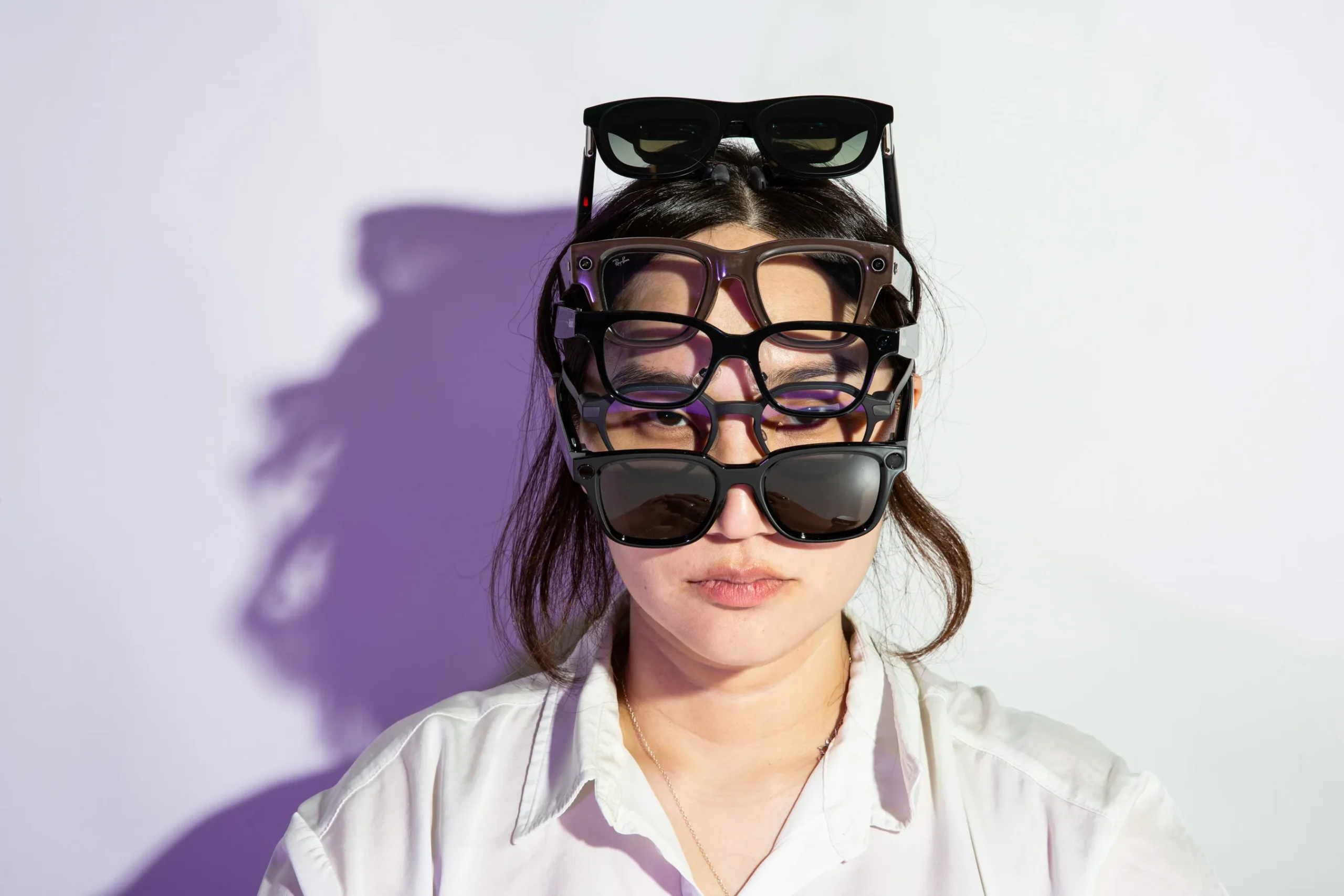
I’m currently wearing a pair of Even Realities G2. Two more pairs from Rokid are sitting on my desk. The Meta Ray-Ban Display is charging nearby, its Neural Wristband coiled next to it. In my closet, there are six pairs of $50 smart sunnies that an overzealous Walmart rep sent me, crammed next to Xreal, RayNeo, and Lucyd glasses, plus an old pair of Razer Anzu. Later today I’m calling my optician because I want to test the new Ray-Ban Meta Optics, which supposedly can handle my tricky prescription.
I have one face. Yet here I am, drowning in smart eyewear.
And more is on the horizon. Every major tech company seems to be betting that glasses are the next big form factor after smartphones. I’m not convinced they’re wrong, exactly. The hardware has genuinely improved over the past couple of years. The G2s are lighter than my regular prescription frames. The Meta Ray-Bans look like normal sunglasses until you tap the temple. Even the cheap Walmart ones feel surprisingly solid for fifty bucks.
But here’s the thing nobody wants to say out loud: we have all these smart glasses, and there’s still almost nothing interesting to do with them.
Notifications on your face are not a killer app. Taking hands-free photos is neat for about a week. The AI assistants built into most of these are worse than asking Siri a question in 2015. And the AR overlays? They’re either gimmicky demos or straight-up broken in anything but perfect lighting.
I’ve been testing wearables long enough to remember the first wave of smartwatches. Same problem. Great hardware looking for a reason to exist. The difference is that watches eventually found their groove: fitness tracking, quick notifications, payments. Glasses haven’t found theirs yet, and I’m starting to wonder if they ever will.
The privacy angle alone is a massive hurdle. Walk into a coffee shop wearing smart glasses and people assume you’re recording them. Even if you’re not, the social friction is real. I’ve had friends ask me to take them off during dinner. I’ve been told to leave a bar because the staff thought I was filming. The Meta Ray-Bans have a tiny LED indicator, but nobody notices it. The Even Realities G2 has no indicator at all. That’s a trust problem that hardware specs can’t fix.
Then there’s the battery life. Most of these last 4-6 hours of active use. That’s fine for a demo, useless for a full day. You’re either carrying a charging case or you’re taking them off by 3 PM. For something that’s supposed to replace or augment your primary device, that’s not good enough.
The prescription issue is another one. I’ve worn glasses since I was twelve. Every pair of smart glasses I’ve tested has either required me to wear contacts underneath or accept some compromise with the prescription inserts. The new Meta Optics supposedly handle high-index prescriptions, but I’ll believe it when I see it. If you can’t make smart glasses work for people who already need glasses, you’re cutting out a huge chunk of your potential market.
I’m not saying this category is doomed. The Ray-Ban Meta collaboration actually sold decent numbers, and the form factor keeps getting better. But the industry needs to stop pretending that shoving a screen and a camera into a frame is a product. It’s a platform. And right now, nobody’s built the app that makes it click.
Maybe it’s AI. Maybe it’s a new kind of interface. Maybe it’s something we haven’t thought of yet. But until then, I’ll keep testing these things, one face at a time, and hoping that next year’s model finally has a reason to exist beyond the hardware itself.
Comments (0)
Login Log in to comment.
Be the first to comment!