
You probably don’t think about what happens behind the scenes when you search, translate, or ask Google Photos to find that one blurry photo of your cat. But there’s a custom chip doing the heavy lifting.
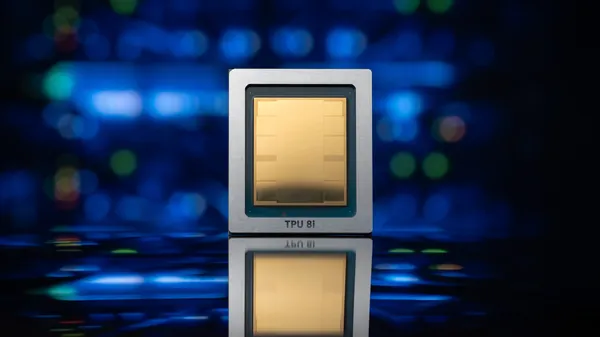
Google’s TPUs (Tensor Processing Units) have been around for more than ten years now. They were never meant to be general-purpose CPUs or even GPUs. They were designed from day one for one specific task: running AI models at scale. And by “scale” I mean the kind of math that would make a normal server farm cry.
AI models run on linear algebra. Matrix multiplications, convolutions, the kind of operations that eat up compute resources like candy. TPUs are built to accelerate exactly that. The newest generation cranks out 121 exaflops of compute power. Let me put that in perspective: that’s 121 followed by 18 zeros floating-point operations per second. And they’ve doubled the memory bandwidth compared to the previous generation.
Why does bandwidth matter? Because in practice, AI workloads are often bottlenecked by moving data around, not by computation itself. You can have the fastest multipliers in the world, but if you can’t feed them data fast enough, you’re just wasting silicon. The TPU team clearly understands that.
There’s a video embedded in the original post that shows the physical chips and some of the engineering behind them. It’s worth watching if you’re into hardware. I won’t embed it here, but you can find it on the Google AI Blog.
I’ve been following TPU development for years, and what impresses me most is that Google didn’t just throw more transistors at the problem. They rethought the architecture. The interconnect between chips, the way memory is laid out, the precision formats they support. It’s not just about raw flops anymore.
Of course, these aren’t chips you can buy off the shelf. They’re only available through Google Cloud. That’s fine for most people, but it does mean you’re locked into their ecosystem if you want to use them. Something to keep in mind if you’re evaluating hardware for your own AI workloads.
Still, 121 exaflops is a number that makes you stop and think. We’ve come a long way from the first TPU that could barely run inference on a single model. Now they’re training massive language models and running real-time services that billions of people use every day.
That’s the part that doesn’t get enough attention. These chips aren’t just benchmarks or research projects. They’re powering products you rely on. And they keep getting better.
Comments (0)
Login Log in to comment.
Be the first to comment!