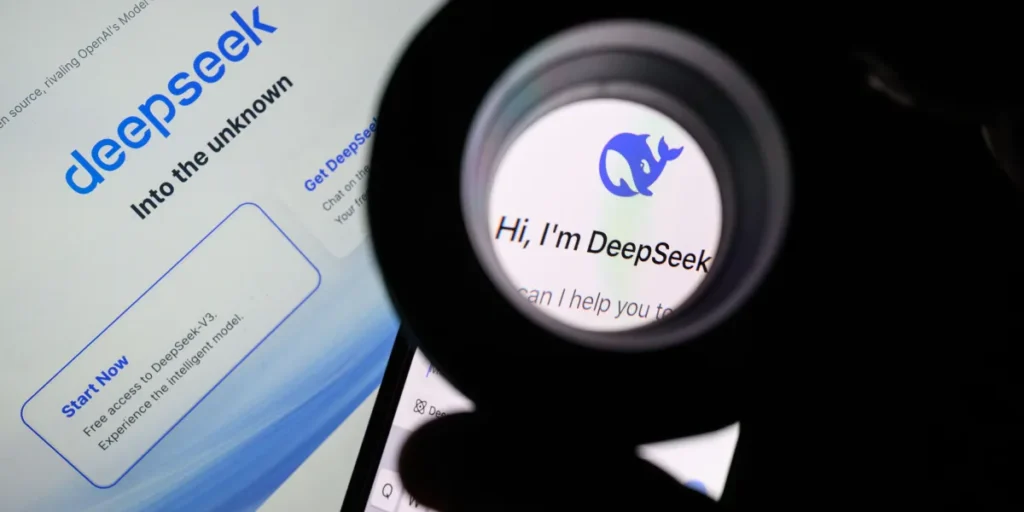

DeepSeek just released V4, its first major flagship model since R1 took the AI world by storm back in January 2025. If you blinked, you might have missed it—the company has been keeping a low profile, dealing with personnel departures, delayed launches, and scrutiny from both US and Chinese regulators. But V4 is here, and it’s worth paying attention to.
Let’s get the obvious out of the way: this isn’t going to shake the industry the way R1 did. That was a once-in-a-blue-moon moment where a scrappy Chinese team trained a killer reasoning model on limited compute and made everyone question whether the big labs were wasting money on GPU farms. V4 is more of a refinement play. But that doesn’t mean it’s boring. Here’s what actually matters.
It’s open-source, and it’s damn good
DeepSeek has always been pro-open-source, and V4 continues that tradition. You can download, use, and modify the model yourself. That alone is a big deal because most frontier models are locked behind APIs with usage limits and pricing that can make you wince. V4 comes in two flavors: V4-Pro for heavy lifting like coding and complex agent tasks, and V4-Flash for faster, cheaper inference.
The pricing is absurdly low. V4-Pro costs $1.74 per million input tokens and $3.48 per million output tokens. Compare that to OpenAI’s GPT-5.4 or Anthropic’s Claude-Opus-4.6, and you’re looking at a fraction of the cost. V4-Flash is even cheaper: $0.14 per million input tokens and $0.28 per million output tokens. That’s practically pocket change for building applications on top of it.
And the benchmarks? DeepSeek claims V4-Pro matches or exceeds the top closed-source models on coding, math, and STEM problems. It also leads among open-source models on agentic coding tasks and multistep reasoning. The company ran an internal survey of 85 experienced developers, and over 90% included V4-Pro among their top picks for coding. That’s not just marketing fluff—those are real developers who actually use these things.
A million tokens without the memory tax
One of the biggest pain points with large language models is the context window—how much text they can process at once. Most models cap out at 128k or 256k tokens, and even then performance degrades as you approach the limit. DeepSeek V4 handles 1 million tokens, which is roughly equivalent to three volumes of “The Three-Body Problem” or a small library’s worth of documentation.
But raw capacity isn’t the innovation here. The real trick is how they manage memory. DeepSeek claims V4 uses a new architecture that makes long-context processing more efficient. I haven’t seen the full technical details yet, but if it works as advertised, it means you can dump a massive codebase, a legal document, or a year’s worth of chat logs into the prompt without the model losing its mind or burning through your budget. This is a practical win for anyone building tools that need to understand large bodies of text.
This is a signal, not a shock
Let’s be honest: V4 isn’t going to make OpenAI or Anthropic panic. But it does tell us something important about the state of AI development in China. DeepSeek has gone from an unknown research team to a symbol of China’s AI ambitions in just over a year. Despite internal turmoil and external pressure, they’re still shipping competitive open-source models at prices that undercut everyone.
That’s not just a flex—it’s a strategy. By keeping models open and cheap, DeepSeek is building an ecosystem. Developers who build on V4 today are likely to stick with the platform for future iterations. And if the model performs even close to what the benchmarks suggest, it’s a viable alternative for anyone tired of vendor lock-in or API rate limits.
Will V4 change the world? Probably not. But it gives developers more choice, pushes prices down, and proves that open-source models can hang with the best of them. That’s a win, even if it doesn’t make headlines.
Comments (0)
Login Log in to comment.
Be the first to comment!