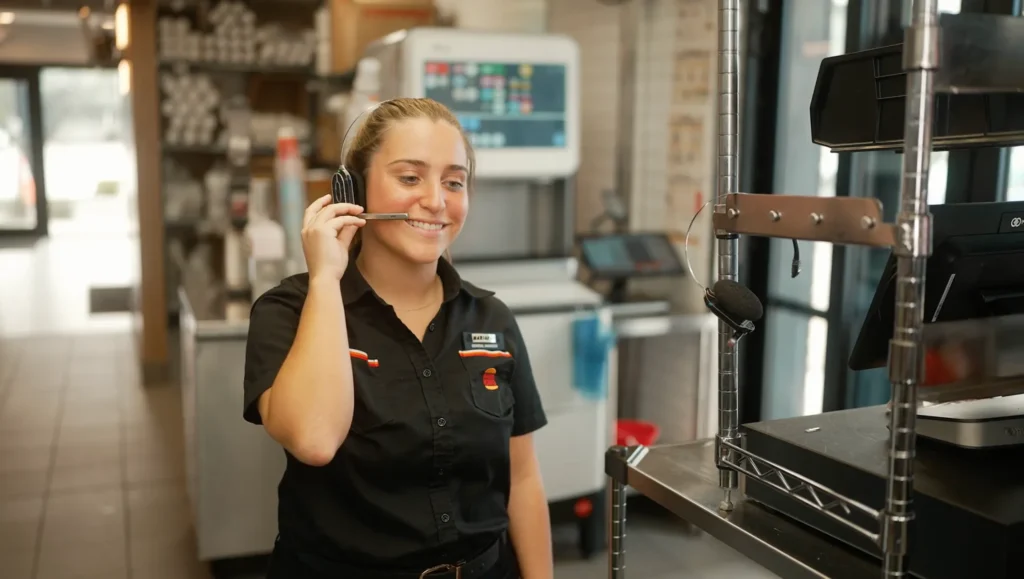

Burger King is putting an AI chatbot inside its employees’ headsets. Not to take orders—at least not yet—but to listen in on how they talk to customers. The chatbot, named Patty (yes, really), is part of a broader platform called BK Assistant, and it’s designed to do two things: help workers with their jobs, and grade them on whether they say “please” and “thank you.”
Let that sink in for a second. An AI is going to be listening to fast food employees’ conversations in real time, checking for politeness. Thibault Roux, Burger King’s chief digital officer, told The Verge that the company worked with franchisees and guests to figure out what “friendliness” looks like, and then trained the AI to recognize specific phrases like “welcome to Burger King,” “please,” and “thank you.” Managers can then ask Patty how their location is doing on the friendliness front.
Roux calls it a “coaching tool.” And sure, on paper, that sounds reasonable. But I can’t help thinking about the flip side: an always-on microphone in a headset, evaluating workers on niceness. That’s a slippery slope. Roux mentioned they’re “iterating” on capturing tone as well, which means the AI might eventually judge not just what you say, but how you say it. That feels less like coaching and more like surveillance with a smile.
The Patty chatbot runs on OpenAI’s tech and acts as the voice of the BK Assistant platform. It pulls data from drive-thru conversations, kitchen equipment, inventory, and pretty much everything else in the restaurant. Employees can ask it practical questions—like how many strips of bacon go on a Maple Bourbon BBQ Whopper, or how to clean the shake machine. That part is genuinely useful. Anyone who’s worked in fast food knows how much time gets wasted hunting down answers to those kinds of questions.
Because Patty is integrated with Burger King’s new cloud-based point-of-sale system, it can also alert managers when a machine goes down or an item goes out of stock. According to Roux, within 15 minutes of an item running out, the entire system—kiosks, drive-thru menus, digital boards—will update automatically. That’s actually impressive. It’s the kind of operational efficiency that makes a real difference in a busy restaurant.
Burger King is being cautious about full AI drive-thrus, though. Chains like McDonald’s, Wendy’s, and Taco Bell have all tried voice-based ordering, with mixed results. Roux is honest about it: “We’re tinkering with it, we’re playing around with it, but it’s still a risky bet. Not every guest is ready for this.” They’re currently testing AI drive-thru tech in fewer than 100 locations. That’s smart. Rushing into something that frustrates customers is a fast way to lose business.
The BK Assistant web and app platform is supposed to roll out to all US restaurants by the end of 2026. Patty itself is piloting in 500 locations. So this isn’t some distant concept—it’s happening now.
I get why Burger King is doing this. Labor turnover in fast food is brutal, and consistency is hard to maintain. Having a tool that helps new hires learn the ropes and reminds everyone to be polite isn’t inherently bad. But the line between helpful coaching and creepy monitoring is thin, and Patty is standing right on it. If I were working at Burger King, I’d want to know exactly what Patty is recording, who has access to that data, and how long it’s stored. Because once you put an AI in someone’s ear, it’s not just a helper anymore—it’s a witness.
Comments (0)
Login Log in to comment.
Be the first to comment!